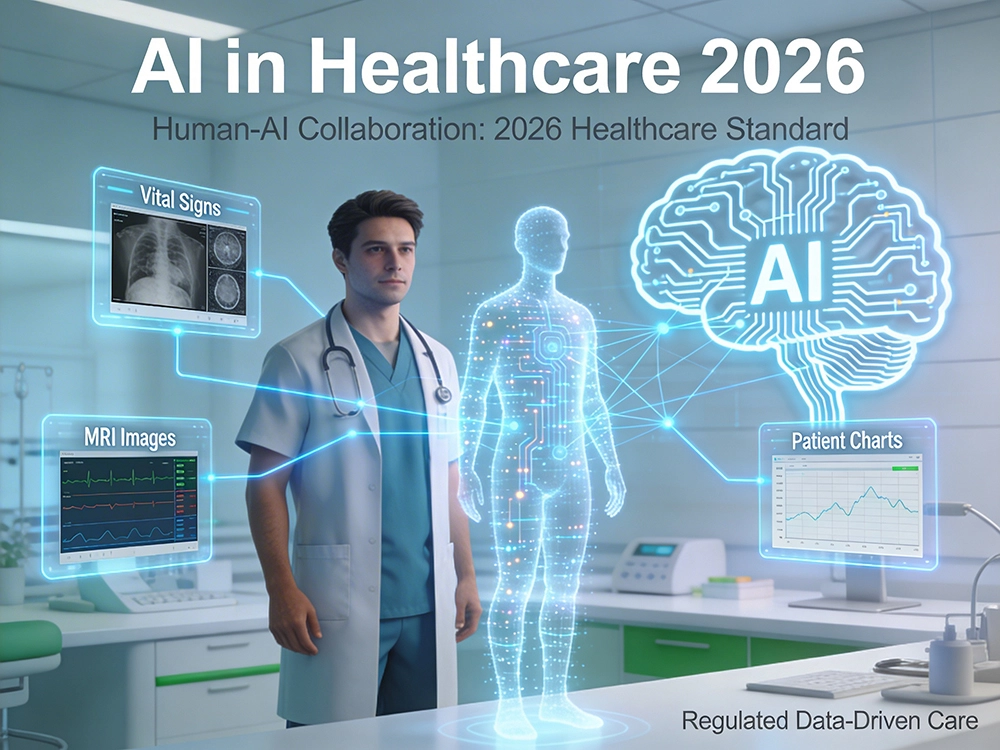
In 2026, artificial intelligence in healthcare has finally crossed the line from glossy conference slides to regulated, reimbursed clinical reality. Hospitals are running AI tools inside their electronic health record (EHR) systems every minute of the day. Insurers are paying for algorithms the way they used to pay only for pills and procedures. Regulators are no longer asking whether AI belongs in medicine, but under what conditions it is safe, auditable, and fair.
What makes this moment structurally different from the "digital health hype" of the late 2010s is that three hard constraints have aligned at once: The economics of healthcare are breaking under the weight of chronic disease and labor shortages. The necessary infrastructure — interoperable EHRs, cloud platforms, and labeled data — is finally in place at scale. Regulators have built the first real scaffolding for how "Software as a Medical Device" (SaMD) and learning algorithms can live inside the clinical and payment system.
AI in healthcare is no longer a speculative theme; it is a capital cycle.
1. From Pilots to Production: AI as a Line Item, Not a Slide
For most of the last decade, hospital CIOs could point to "AI pilots" the way corporates once pointed to innovation labs: proof that they were modern, with minimal obligation to show financial results. That era has ended.
Three macro forces pushed AI out of the sandbox and into the budget: Labor shortages became systemic, not cyclical. With aging populations and clinician burnout, many health systems simply cannot hire enough nurses, radiologists, and primary care physicians at any price. Payment models shifted toward risk and outcomes. Value‑based care, shared savings, and capitated contracts mean that providers who manage to keep patients out of the hospital get to keep more of the premium dollar. Cloud‑based EHR penetration reached critical mass. Once large swaths of the system moved to standardized, API‑accessible records, AI vendors and in‑house data teams finally had a substrate to work with.
On the ground, the most visible expression is where AI shows up in the P&L: operating budgets as per‑bed software fees, capital budgets for imaging and pathology modernization, and contract clauses where vendors are paid based on achieved KPIs.
2. Clinical AI: Narrow Algorithms, Real Money
The revenue in 2026 is in narrow, deeply embedded tools that shave minutes, reduce error probabilities, or move a few percentage points in outcomes — at enormous scale.
2.1 Radiology and Cardiology: From "Second Read" to Default Filter
Imaging was always the leading edge of clinical AI. Today's winning products pre‑triage studies, automate measurements, and standardize reporting. Economically, radiology groups increase RVUs per radiologist by 10‑20% and reduce missed critical findings.
2.2 Sepsis, Deterioration, and "Predict-and-Prevent"
On the inpatient side, early‑warning systems for sepsis detection and deterioration scores are financially relevant. When tuned properly, modest improvements translate into shorter length of stay, fewer ICU days, and lower mortality.
3. Back‑Office AI: Revenue, Coding, and Administrative Bloat
If clinical AI saves lives, back‑office AI keeps the lights on. Prior authorization, denials management, and ambient clinical documentation have gone from novelty to expectation. For large health systems, a 2–3 percentage point swing in denial rates can mean tens of millions in annual revenue.
4. Pharma and Life Sciences: AI as R&D Force Multiplier
Generative models allow inverse design and multi‑objective optimization. AI plays a critical role in synthetic control arms, site selection, and eligibility matching. The business implication is shorter, cheaper trials with higher probability of success.
5. Infrastructure: Data Pipelines, Cloud, and "Shared Rails"
The shift from islands of data to usable datasets has been driven by FHIR APIs, cloud data platforms, and master patient indices. The dominant pattern for safety‑critical workloads is hybrid: models updated centrally, deployed as versioned containers on‑prem.
6. Regulation: From "Black Box" Panic to Governance Frameworks
SaMD frameworks define when AI requires premarket clearance. Predetermined Change Control Plans allow models to be updated without full re‑approval. Most commercial tools are framed as "decision support" with clinicians in the loop.
7. Business Models: Who Actually Gets Paid?
Winners tend to be horizontal platforms embedded in the EHR or point solutions with provable ROI. Many deals involve vendor, provider, and payer — with shared savings agreements.
8. Risks, Bias, and the Politics of AI in Medicine
Organizations are auditing models for differential performance, adjusting thresholds, and in some cases choosing simpler models. Over‑reliance, deskilling, and security remain concerns.
9. Investment Takeaways: Where the Durable Edge Likely Sits
The more robust opportunities cluster in: AI‑native infrastructure tied to the EHR, narrow high‑ROI clinical tools, back‑office AI, and life sciences platforms. Deep integration, clear links to revenue or cost metrics, and governance built in from day one.